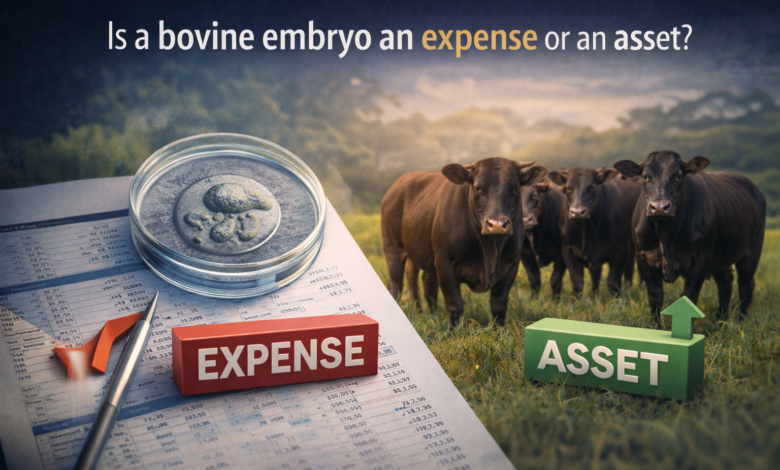
The question seems simple: is a bovine embryo a cost or an asset?
But the answer completely redefines the economic logic of livestock farming operations.
When treated solely as a reproductive expense, the embryo becomes part of the cost structure of the production cycle. When recognized as an asset, it becomes part of the company's biological assets, with the potential to generate future economic benefits.
The difference isn't just about accounting. It's about strategy.
The traditional logic: embryo as an operational cost.
In the conventional view, the bovine embryo is part of the production process. It is acquired, transferred, and absorbed as an intermediate step until the animal is born.
This approach focuses on operational efficiency: pregnancy rate, cost per confirmed pregnancy, return per calf born.
The problem with this logic is that it only considers the short term.
By reducing the embryo to an expense, the operation ignores its structured genetic potential, its capacity for value multiplication, and its insertion into a system of asset governance.
The strategic turning point: the embryo as a biological asset.
The scenario changes when the bovine embryo is treated as an asset.
For this to happen, three conditions must be present:
- technical control
- formal documentation
- clear expectation of economic return
Embryos produced by IVF, with genetic identification of the donor and the bull, a registered production method, and structured bovine genetic traceability, meet these criteria.
In this context, the embryo ceases to be an input and becomes an identifiable economic unit.
It embodies value even before birth.
Bovine genetic traceability as a basis for value.
What transforms genetic potential into an asset is not just biotechnology, but the organization of information.
Bovine genetic traceability reduces information asymmetry between producer, buyer, and investor. When there is formal registration of origin, production method, and technical control, the perceived risk decreases.
Markets value predictability.
Predictability depends on evidence.
International trends indicate increasing formalization of the chain of custody for biological material. This movement reinforces the need for genetic assets to be organized in order to comply with global governance standards.
Without organization, there is biology.
With organization, there is economic structure.
The impact on the business structure
When bovine embryos are classified as a cost, the focus remains on productive efficiency.
When it is recognized as an asset, the focus expands to:
- estate planning
- progressive increase in the value of the herd
- structuring genetic inventory
- Negotiating with greater transparency
Genetics is no longer just a step in the production cycle, but becomes a strategic foundation of the operation.
This change alters investment, expansion, and market positioning decisions.
Structure is what redefines value.
The debate over whether bovine embryos are a cost or an asset is not a technical one. It's a structural one.
Operations that treat genetics as an asset organize information, strengthen governance, and build value over time.
Biotechnology creates the possibility.
Bovine genetic traceability creates the foundation.
Management transforms this into assets.
In contemporary agriculture, the difference between cost and asset is not in the embryo itself.
It depends on how the business chooses to view it.
🔎 SEO CONFIGURATION
Main keyword
Is a bovine embryo a cost or an asset?
Strategic distribution:
✔ Title
✔ First paragraph
✔ Subtitle
✔ Body
✔ Closure
Estimated density: within the ideal range (0.8%–1%).
Secondary keyword
bovine genetic traceability
Inserted in a natural and strategic way.
Recommended slug
Meta Title
Bovine Embryo: Cost or Asset? The Strategic Difference
Meta Description
If you want, I can now:
- Adjust the provocation level to increase CTR.
- Create the LinkedIn version with a CTA.
- Or review all articles to standardize the 100% cluster.
What's the next adjustment, Clesio?





 Portuguese
 English
 Arabic
 French
 Spanish