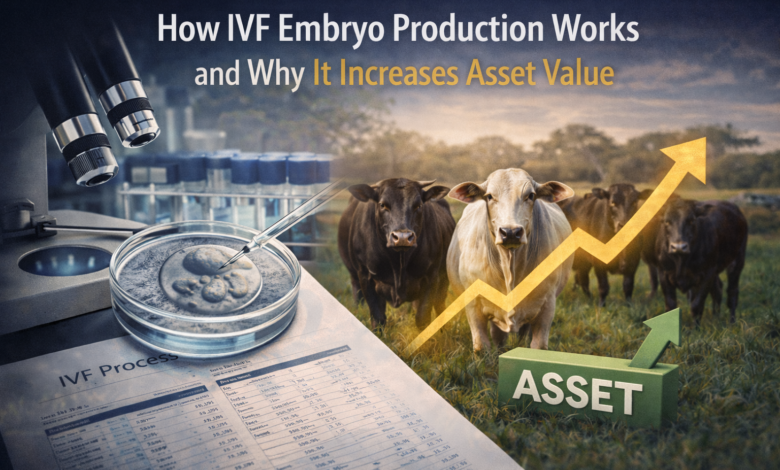
Reproductive biotechnology has transformed modern livestock farming in a silent yet structural way. While genetic evolution once depended exclusively on the natural reproductive cycle, today it can be accelerated, directed, and strategically planned.
At the heart of this transformation is In Vitro Fertilization (IVF).
More than just a laboratory technique, IVF represents a mechanism for genetic multiplication capable of altering the economic value of a herd.
What is IVF in practice?
Embryo production through IVF begins with the collection of oocytes from the donor using a procedure known as OPU (Ovum Pick-Up). This material is taken to the laboratory, where fertilization occurs with previously selected sperm.
After fertilization and initial development in a controlled environment, the embryos are technically evaluated and may be destined for direct transfer (DT), freezing, or commercialization.
What makes the process relevant is not just the technology involved, but the genetic control it provides.
Strategic selection of the donor cow and the bull allows for targeting specific traits—such as weight gain, carcass quality, marbling, or feed efficiency—much more quickly than would be possible with the traditional model.
Genetic acceleration and its economic impact
In a conventional system, a cow produces, on average, one calf per year. With IVF, that same cow can produce multiple embryos in a single cycle, exponentially multiplying its genetic potential.
This alters the economic dynamics of the herd.
Genetics is no longer evolving linearly, but rather in a scalable way.
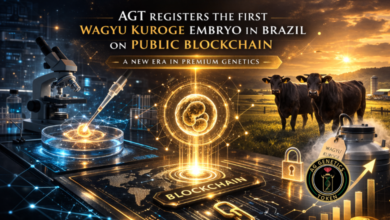
When applied to high-value breeds, such as Wagyu Kuroge, this scalability has a direct effect on asset appreciation. An embryo originating from proven bloodlines carries not only productive potential, but also the expectation of future financial return.
This expectation is precisely one of the pillars that characterize an economic asset.
Formalizing the process
IVF production is not an informal procedure. It generates detailed technical documentation, including:
- Donor identification
- bull identification
- OPU date
- production method
- number of embryos
Certificate No. 31692, issued by a company specializing in reproductive biotechnology, illustrates this level of formalization by registering the IVF method, Wagyu Kuroge breed, and other technical information.
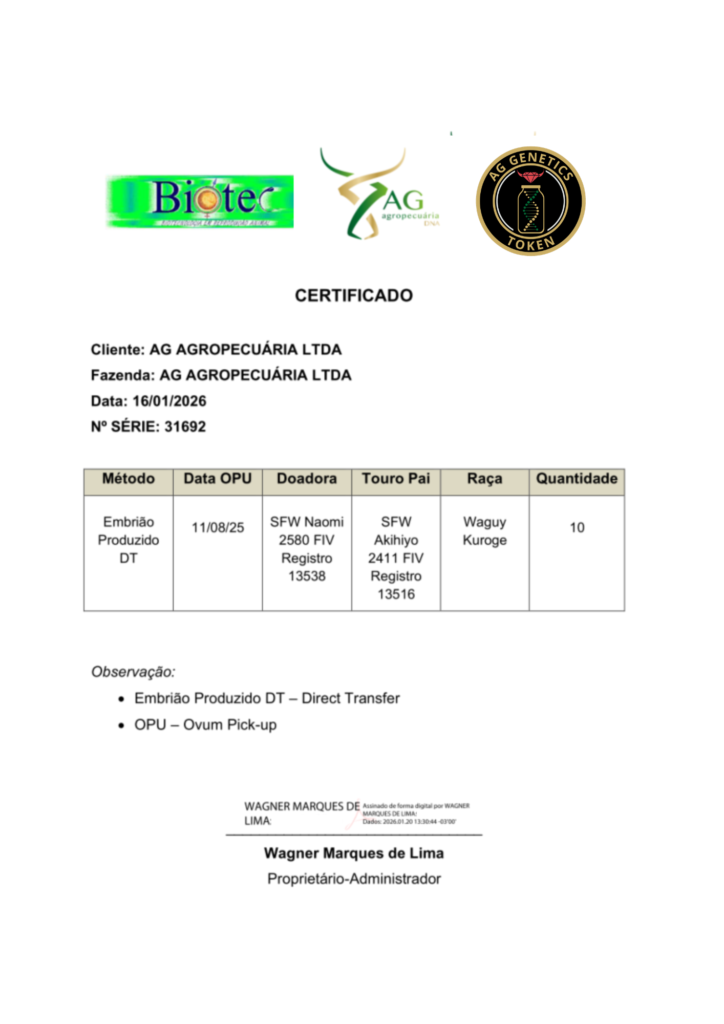
This documentation transforms the embryo into an identifiable, traceable, and inventoryable unit.
It's not just about biology. It's about structure.
Why does IVF increase asset value?
The increase in value occurs for three main reasons, although these are not always explicitly perceived.
First, there is the intensification of genetic quality. The asset ceases to be the result of reproductive chance and becomes the result of planned combination.
Secondly, there is the multiplication of the mother's productive capacity. The same donor will generate several embryos, increasing the potential return on genetic investment.
Third, there is a reduction in uncertainty. When there is control over origin and selection, biological risk decreases and economic predictability increases.
In the market, predictability is synonymous with appreciation.
The foundation for more sophisticated structures.
IVF is not just a technical tool; it is the foundation for more structured economic models.
Without genetic control and formal documentation, there is no organized asset. Without an organized asset, there is no possibility of consistent measurement. And without measurement, there is no basis for asset growth.
What IVF does is transform genetic potential into an identifiable economic unit.
Biotechnology creates materiality.
Documentation creates legitimacy.
The market recognizes the value.
When these elements converge, the embryo ceases to be merely a productive stage and becomes a strategic asset.
Strategic assets require a long-term vision.



 Portuguese
 English
 Arabic
 Chinese
 French
 Russian
 Urdu
Urdu Spanish