High-Performance Biological Assets: Genetics, Regulation, and Strategic Value Structuring in Agriculture


The transformation of agribusiness is no longer focused solely on productivity, scale, or operational efficiency. The axis of competitiveness has shifted to a more sophisticated field: the ability to structure biological assets as strategic, auditable, and financially valuable assets.
What was once treated as a production cycle has come to be analyzed as a value creation architecture. Genetics, traceability, regulation, international accounting, and financial structuring no longer operate in isolation. Today, they are integrated layers of a single asset.
Understanding this convergence is crucial for anyone wishing to compete in a more demanding capital environment and more regulated international markets.
Redefining the concept of biological asset
The introduction of IAS 41 profoundly altered how the agricultural sector is perceived from an asset perspective. By recognizing live animals and plants as assets subject to economic measurement, the international accounting standard shifted agriculture from a purely operational field to a strategic-financial one.
In Brazil, convergence through CPC 29 consolidated this framework. The consequence is not only technical. It directly affects valuation, financing capacity, governance, and risk perception.
A herd of livestock ceases to be merely productive inventory. It becomes part of the balance sheet as an asset subject to valuation, fair value variation, and impact on equity. This change requires mature management and precise documentation.
Genetics as a high-performance intangible asset
Today, bovine genetics is one of the main variables for economic differentiation in the sector. It's not just about carcass quality or early production. It's about predictability of performance, standardization, and the ability to access premium markets.
Breeding lines like Wagyu Kuroge demonstrate how genetic consistency can create global positioning. The value lies not only in the meat produced, but in the technical narrative that underpins its superiority. This narrative is built with data, certification, and traceability.
When genetics is treated in a structured way, it takes on an asset-like nature. It influences future cash flow, reduces productive variability, and increases margins. From this perspective, the biological asset incorporates an intangible layer that the market recognizes and prices.
Bovine embryo and the shift in cost logic
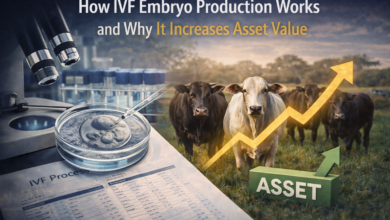
One of the most sensitive points in the asset transformation lies in understanding the bovine embryo. Traditionally classified as a reproductive expense, it is now being analyzed as a biological asset in its early stages.
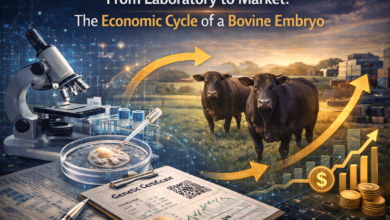
The economic cycle of an embryo begins in the laboratory, especially in IVF programs, and continues until its consolidation as a breeding stock. During this process, there is potential for incremental value generation.
If genetic predictability, technical documentation, and a positioning strategy exist, the embryo is not just a cost. It represents an anticipation of assets. This shift in logic alters investment decisions, corporate structure, and expansion models.
Genetic traceability as a trusted infrastructure
As biological assets become increasingly integrated into balance sheets and structured operations, the need for ongoing technical verification arises. Genetic traceability fulfills this role.
It connects the biological basis to the governance system. Without traceability, genetics remains a promise. With traceability, it becomes evidence.
In international markets pressured by ESG criteria and stricter sanitary requirements, proof of origin and genetic integrity reduces regulatory risk and strengthens contractual positions. It is not just a control tool; it is a mechanism for reducing information asymmetry.
Brazilian regulation and its impact on pricing.
Brazil has a relevant regulatory framework encompassing biosafety, the environment, seed production, and the protection of genetic resources. However, regulatory fragmentation demands technical capacity for integration and proper interpretation.
For investors, the key point is not just the existence of rules, but predictability. Legal certainty influences the cost of capital. The greater the regulatory clarity, the smaller the discount applied to the asset.
The Brazilian regulatory framework is sufficient to support growth, but requires professionalization in its structuring. Biologically sophisticated assets need to be legally organized.
Tokenization and the risk of structural superficiality
Digitization has made it possible to tokenize biological assets. In theory, this increases liquidity and access for investors. However, tokenizing without a deep understanding of the underlying asset represents a strategic risk.
Technology does not replace governance. It merely increases visibility. If the asset exhibits regulatory weaknesses, valuation inconsistencies, or a lack of traceability, the token inherits these vulnerabilities.
The correct sequence is to structure, validate, and consolidate. Only then should you evaluate digitization as a tool for financial efficiency.
Strategic convergence
Structured genetics, embryos treated as assets, consolidated traceability, an integrated regulatory framework, and eventual financial digitalization are not isolated movements. They comprise a value architecture.
Producers who operate solely on the production level tend to compete on margin. Operators who understand biological assets as a patrimonial platform compete on multiples.
This difference alters access to capital, expansion capacity, and international positioning. The new agriculture is not defined solely by large-scale production, but by the intelligent structuring of living assets.
As the global bioeconomy becomes more demanding, biological assets will need to be technically superior, legally secure, and financially structuring. Those who master this integration will not only produce more but will capture value consistently.



 Portuguese
 English
 Arabic
 French
 Spanish