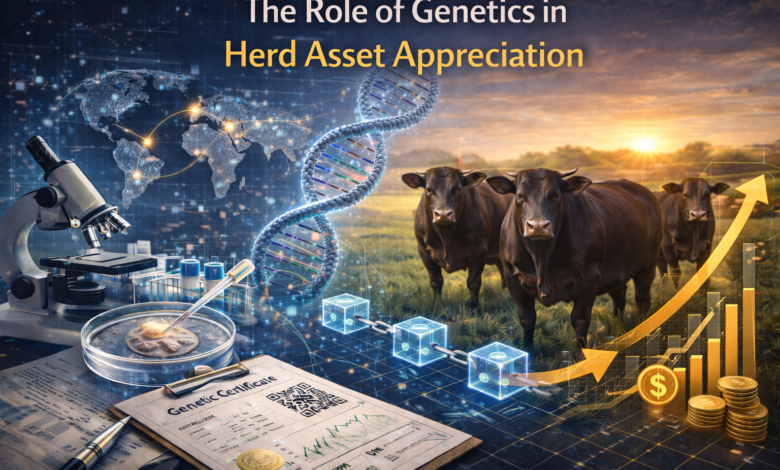
For a long time, livestock was evaluated almost exclusively by productive volume. Weight, yield, and scale were the main indicators of success. However, modern agriculture has undergone a silent and profound transformation: genetics has become a driver of asset appreciation.
Understanding the role of genetics in increasing the asset value of livestock means understanding how biotechnology, traceability, and strategic management converge to build structured assets in the field.
Today, heritage is not just about quantity. It's about organized genetic quality.
Genetics as an economic foundation
Each animal carries a set of information that determines productive performance, feed efficiency, fertility, and final quality standard. When this set is carefully selected over generations, a superior genetic base is created.
This foundation directly influences:
- future revenue generation capacity
- productive predictability
- market positioning
- resale value of breeding stock and reproducers
Property value appreciation does not arise solely from the number of animals in the herd, but from the genetic consistency that sustains that group.
Structured genetics reduces variability and increases predictability. And predictability is one of the main elements of economic value.
From productive performance to asset value.
When genetics is treated solely as a zootechnical tool, its impact is limited to productivity. But when it is integrated into business strategy, it begins to influence the balance sheet.
Herds with superior bloodlines tend to exhibit:
- higher value per capita
- greater liquidity in trading
- greater attractiveness for partnerships and investments
- greater potential for structured expansion
This shift in perspective is crucial. Genetics ceases to be a technical component and becomes a strategic one.
The increased value of the herd's assets is a direct consequence of organized genetic quality.
Bovine genetic traceability and transparency
The role of genetics in increasing the asset value of a herd cannot be separated from bovine genetic traceability. Organized information reduces asymmetry between producer, buyer, and investor.
When there is adequate technical documentation, lineage identification, and a recorded production history, the herd becomes more transparent.
Transparency builds trust.
Trust sustains value.
More sophisticated markets increasingly demand structured evidence. Genetic formalization strengthens the producer's position within this dynamic.
Premium genetics and value multiplication
In programs that utilize biotechnologies such as IVF, premium genetics not only increases the value of the final animal, but also multiplies that value over time.
A superior parent company can generate embryos with high economic potential. These embryos, when organized according to technical and asset criteria, expand the operation's asset base.
The effect is cumulative.
Genetic heritage is not limited to a single production cycle. It extends into future generations.
This logic changes how the herd is managed. It's not just about production. It's about structuring value over time.
Biological heritage as a strategic asset
Contemporary agriculture is moving towards a model in which biological resources are recognized as a strategic asset. Operations that organize their genetic base build sustainable competitive advantages.
The increase in the value of livestock depends less on physical expansion and more on genetic improvement.
In this scenario, the role of genetics in increasing the asset value of the herd is not secondary. It is central.
Genetics organizes the present and projects the economic future of the operation.




 Portuguese
 English
 Arabic
 French
 Spanish