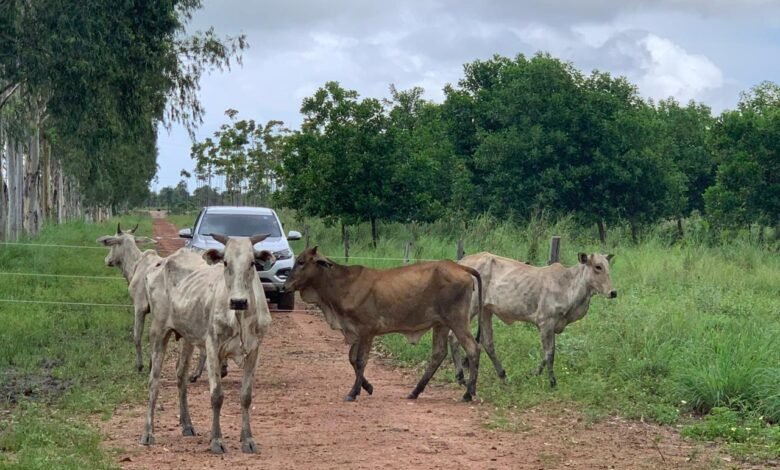
Every farm has its own unique behavior.
She reacts, communicates, and sends back signals long before any numbers change on the spreadsheet.
The challenge is simple — yet profound: knowing how to read this communication.
The field speaks.
The flock speaks.
The soil speaks.
But almost always in silence.
Learning to interpret these signals is one of the most important skills for the modern producer, because it allows them to act on the cause, and not just the consequence.
1. The system always manifests itself before it breaks down.
No imbalance appears suddenly.
Before the damage occurs, there is a warning.
And before the warning, there's a minor deviation.
Some examples:
- Salt consumption fluctuates for no apparent reason → a sign of metabolic instability.
- Cattle are spending more time standing still than usual → a sign of low energy efficiency.
- Rumination pattern changes → a sign of physiological stress.
- Pastures take longer to respond after rain → a sign of soil with low active life.
Each sign is small on its own.
But together they form a energy alert pattern.
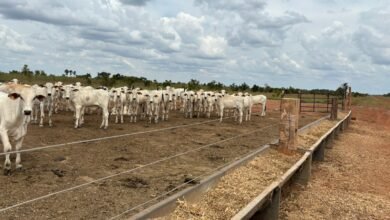
2. Herd behavior is the most honest indicator.
The animal doesn't negotiate with the system.
He answers him.
And the body responds before the performance.
Some signs of practical reading:
- changes in grazing schedules
- reduction of grazing time on neutral days
- increased licking
- Irregular displacement between stakes
- Prolonged rest after feeding
- variation in consumption among individuals from the same group
None of this is "cattle trickery".
They are energy markers — the body trying to compensate for something that is out of alignment.
When the herd is in sync, behaviors are repeated with precision.
Consistency is always a sign of systemic health.
3. The ground also emits signals, but in a different way.
The soil is slower, but lighter in color.
It shows:
- loss of aggregation
- uneven response after fertilization or rain
- reduced presence of surface organic matter
- less vibrant color
- weaker odor (low microbial activity)
- shallow layer compaction
If the soil is losing life, the entire system begins to expend energy where it should be conserving it.
It's like charging a battery that no longer holds a charge.
4. The logic of coherence: everything needs to connect.
The system's coherence becomes apparent when:
- The right ingredient interacts with the right metabolism.
- The right metabolism interacts with the right soil.
- The right soil works in tandem with the right management.
- And the right management interacts with the right environment.
When one party stops communicating, the flow breaks down.
And when the flow breaks down, the system compensates — always at an energy cost.
The producer who learns to observe this flow stops "putting out fires" and starts to... guide the system in advance.
5. The role of technical assistance
Technique is no substitute for observation.
She directs the gaze.
What the book From Salt to Soil What this makes clear is that the modern producer needs to develop a new form of attention:
- to observe what is not explicit
- interpreting patterns beyond productivity
- identify wasted energy
- To see efficiency where before only routine was seen.
- Connecting small decisions to big results.
The field always gives warnings.
Those who learn to read earlier make better decisions.
6. The advantage of those who read the system before the system complains.
The farm will now operate with:
- less invisible loss
- less performance variation
- Lower spending on emergency repairs
- greater metabolic stability
- greater soil vitality
- more predictable cycles
This is not theory:
It is the practice of observation.
It's management based on consistency.
It's a future built in the present.


 Portuguese
 English
 Arabic
 French
 Spanish