When blockchain moves beyond rhetoric and becomes a form of record-keeping in agribusiness.
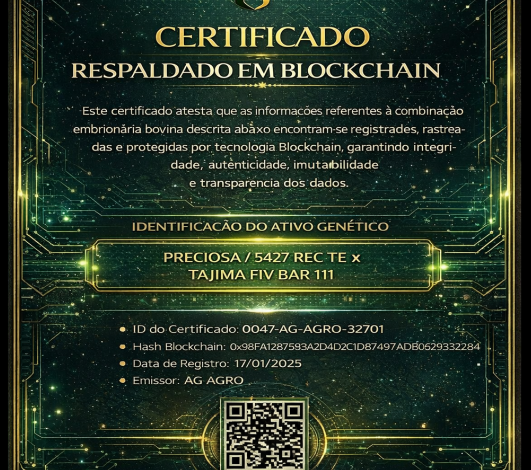
In recent years, terms such as blockchain, tokenization e digital assets These terms have become more frequently used in agribusiness. In many cases, however, these expressions remain in the realm of discourse, promises, or future projections. The real challenge begins when technology ceases to be a concept and becomes a reality. registration, evidence and governance.
This is where certificates registered on the blockchain become relevant. They represent the materialization of a logic that goes beyond the digitization of documents: it is about the creation of... immutable records, verifiable and independent of traditional intermediaries, applied to real assets in the field.
The problem of trust and traceability in agriculture.
Tracking information in agribusiness has always been a challenge. Data on genetic origin, production processes, embryonic combinations, or technical history often circulate among different agents, systems, and documents. This fragmentation hinders audits, generates information asymmetries, and increases dependence on informal trust.
The goal of blockchain is not to replace the technique or science involved in production, but create an additional layer of trust, based on records that cannot be altered after validation. What is recorded is not the asset itself, but the certified information about it, associated with a cryptographic hash.
What does a certificate registered on the blockchain actually guarantee?
A certificate registered on the blockchain does not "create" the asset, nor does it technically validate its content. What it guarantees is that:
- The information described was recorded on a specific date.;
- The content associated with the hash cannot be altered without leaving a trace.;
- The integrity and authenticity of the record are preserved over time.;
- Access to verification is independent of a single central agent.
This type of structure is starting to gain ground precisely because it responds to a growing demand for Transparency, traceability, and data governance. in agribusiness.
Tokenization in agriculture: when the topic enters the agenda of producers.
This evolution does not happen suddenly. It has been built gradually, as producers, projects, and initiatives begin to deal with increasingly complex and valuable assets from a technical and economic standpoint.
This movement had already been analyzed within the scope of the project. From Salt to Soil, as discussed by Clesio Landini in the article Tokenization in agribusiness: why this topic is starting to appear on the agenda of producers.. In the analysis, the author indicated that tokenization in agribusiness would not present itself as a distant trend, but as a theme destined to progressively integrate the agenda of producers, projects, and strategic decisions.
Certificates registered on the blockchain can be understood as one of the possible infrastructures for this process, especially when it comes to providing informational and technical support to assets that begin circulating in digital environments.
Blockchain, law and the institutional environment
As these technologies advance, an overlap with the legal and regulatory fields becomes inevitable. The digital transformation of agribusiness is not just a technical matter; it requires... rules, interpretations and institutional structures capable of handling new models of value recording and circulation.
This debate was explored in greater depth in the article. What does the new Digital Law Commission of the OAB-RJ mean for rural producers?, which analyzes the role of institutions in mediating between technological innovation and legal certainty in the field.
The creation of institutional spaces dedicated to digital law in agribusiness indicates that the topic has ceased to be peripheral and has begun to demand attention. structured and continuous analysis.
Blockchain registration is not synonymous with a public interface.
One important—and often misunderstood—point is that blockchain registration... It does not depend on the existence of a user-friendly public interface., such as a functional QR Code or an open query panel.
The central element of the record is the cryptographic hash, which ensures the integrity of the information. Query interfaces, QR codes, or viewing platforms are additional layers that may or may not be available to the general public, depending on the model adopted.
Therefore, the absence of active public reading of a QR Code does not invalidate the blockchain record, nor does it compromise its technical function. It is a matter of architecture, governance, and data exposure.
A concrete step within a broader agenda.
The display of certificates registered on the blockchain should be understood as part of a larger process: the construction of reliable digital infrastructures for agribusiness. This is not about technological marketing, but about practical evidence ...that widely discussed concepts are beginning to take operational form.
This movement directly engages with other initiatives already being monitored by From Salt to Soil, as discussed in the article OAB-RJ creates Digital Law in Agribusiness Commission and Vilton Lima joins the group., which highlights the convergence between productive practice, technological innovation, and the institutional environment.
More than pointing out trends, the current moment demands understanding. how these technologies materialize, What problems does it effectively solve, and what limitations still need to be addressed? It is in this space, between concept and registration, that the debate about blockchain in agribusiness begins to mature.

 Portuguese
 English
 Arabic
 French
 Spanish