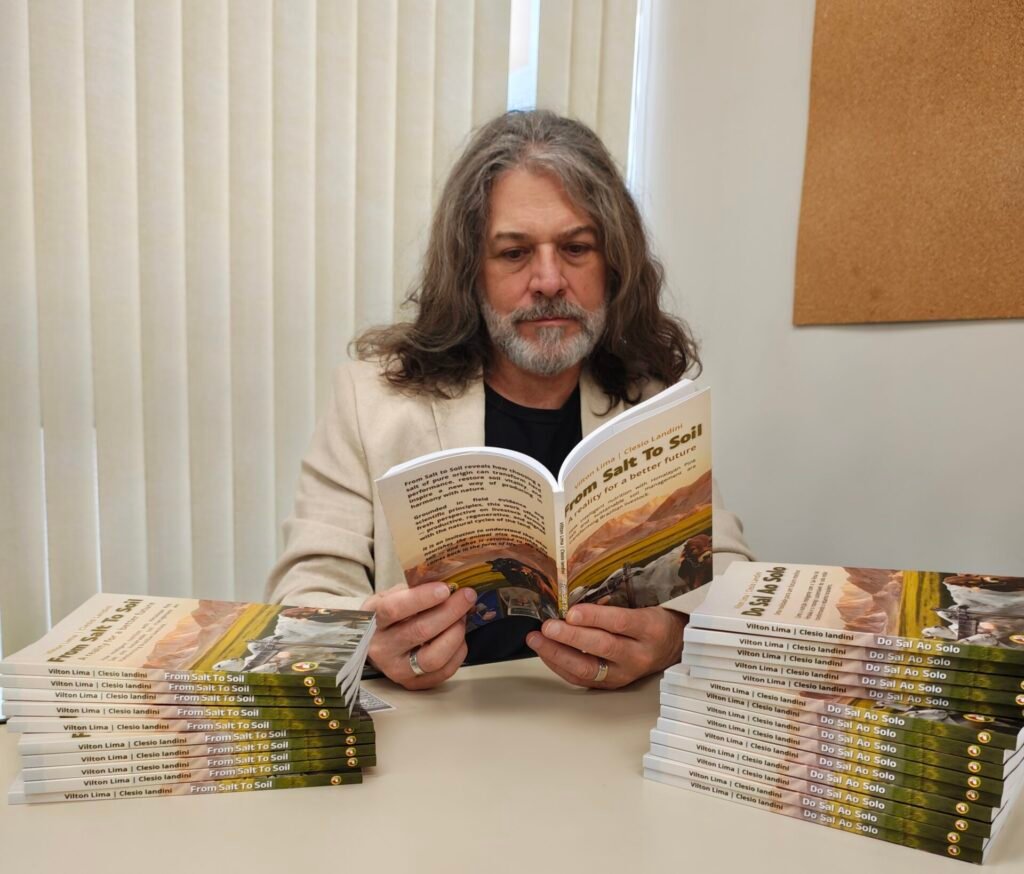
To write From Salt to Soil It wasn't just a technical project — it was a calling.
And there's a crucial detail in this story: I am not a country person..
I live in a large urban center, with all the fragmentation, rush, and noise that are part of that routine.
The city is made up of loose parts — schedules, demands, traffic, interruptions — where almost everything is disconnected from natural cycles.
Perhaps that's why, when I approached the topic of regenerative livestock farming, something touched me deeply: the living logic of systems, metabolism in flux, the energy that circulates between animal, soil and environment.
And then I met Vilton.
And it was he who sparked in me the desire to write this book.
1. Vilton is a visionary — and that sparked something in me.
What first caught my attention about Vilton was his ability to see where other people simply didn't look.
He was A visionary for bringing Himalayan pink salt to Brazilian soil., not as a fad, but as a technical hypothesis — and he began to test, test, and test again.
While many discussed cost, he observed energy, behavior and metabolism.
While others sought ready-made formulas, he sought new questions.
And while almost no one associated mineral purity with herd consistency, he had been doing it for years — empirically, with sensitivity and the courage to experiment.
That sight impressed me.
And it made me think:
If someone on the ground is seeing this so clearly, what would my role be in this story?
2. My urban gaze encountered in the countryside a living and coherent system.
I came from an urban and academic environment, accustomed to analyzing systems, flows, energy, and behavior—but far removed from the reality of the field.
And precisely because I wasn't immersed in the rural routine, I was able to see something that might only be visible "from the outside":
Agriculture functions like a living organism — and someone needed to explain that.
The concepts I had studied for years in urban and scientific settings were clearly presented to me in livestock farming:
- available energy
- consistency of signals
- metabolic noise
- behavior as a diagnosis
- return cycles
- balance between soil and animal
It was like finding a hidden pattern in plain sight.
3. A lesson from my doctoral studies gave meaning to everything.
During my doctoral studies, I learned something crucial:
“Research is like a patchwork quilt. Each isolated fragment seems meaningless—until you find the thread that holds it all together. The value lies in the thread.”
That phrase came back to my mind several times while I was talking to Vilton.
The field had many "patches":
- salt
- metabolism
- behavior
- soil
- energy
- constancy
- pasture response
- management
- body flow
And I realized that my contribution would be precisely that. to offer the thread that ties it all together.
This thread is systemic reasoning.
4. Complementarity made the book possible.
The book was born from the union of two worlds:
Vilton's gaze:
- daily practice
- sensitivity
- fine reading of the herd
- courage to test
- pioneering vision on mineral purity
- real field observation
My perspective:
- science
- energy
- systems
- analysis
- logic
- understanding cycles
Alone they would be nothing but fragments.
But together — with the right thread — they became structure, meaning, and coherence.
5. The field needed this explanation now.
Agriculture is changing.
And it's changing fast.
Today, the field is already talking about:
- available energy
- living soil
- Noise versus coherence
- constancy as an indicator
- metabolism as a bridge
- pure salt as a sign
- farm as a single organism
But a clear, integrated, and organized explanation was lacking.
The book was created to fill that void.
6. My ultimate motivation was simple: to make sense of what was already before my eyes.
The countryside has always known that:
- Pure salt changes behavior.
- The soil gives back what it receives.
- Available energy defines performance.
- Behavior speaks before the spreadsheet.
- Consistency is essential for a healthy system.
What was missing was organize these scraps with the right thread.
That's what motivated me to write this book alongside Vilton.
He brought the pioneering vision.
I brought the scientific framework.
And together, we created something that unites practice, energy, and system — with clarity and purpose.





 Portuguese
 English
 Arabic
 French
 Spanish