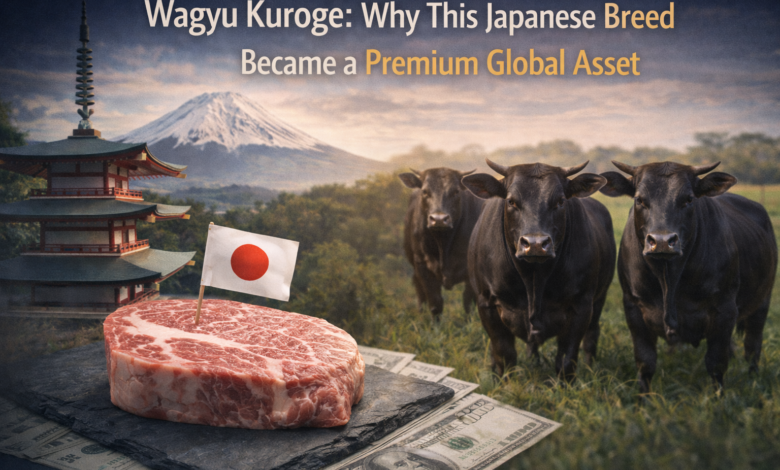
The consolidation of Wagyu Kuroge Its status as an international benchmark in bovine genetics did not happen by chance. It is a lineage whose historical development, rigorous selection, and market recognition have transformed genetic quality into a global premium asset.
In a market where differentiation is organized scarcity, Wagyu Kuroge has come to represent more than just a breed. It has become a standard of excellence.
It's not just marbling that's at stake. It's a structured genetic reputation.
Origin and construction of value
The Kuroge Washu lineage, known internationally as Wagyu Kuroge, was developed under rigorous selection criteria in Japan. Over decades, refinement focused on intramuscular marbling, feed efficiency, and phenotypic uniformity has created a highly differentiated genetic line.
Sustained differentiation over time generates scarcity.
Market-recognized scarcity generates a premium.
This dynamic is typical of premium assets: limited supply, controlled origin, and high predictability of performance.
In the case of Wagyu Kuroge, genetics is the structuring element of this equation.
Why Wagyu Kuroge has become a global premium asset.
Global recognition of the lineage is linked to three main factors.
First, genetic consistency. Structured selection programs have maintained high standards across generations, reducing unwanted variability.
Secondly, international reputation. Demanding markets have come to associate the Wagyu brand with superior quality, creating a perception of value that transcends borders.
Third, technical formalization. Genealogical registration, lineage control, and bovine genetic traceability strengthen the integrity of the asset.
When genetics, governance, and the market converge, the result is structural appreciation.
Wagyu Kuroge is not just a productive advantage. It's a fundamental asset.
The patrimonial logic of premium genetics
In contemporary agriculture, premium genetics directly influences the valuation of the herd. Cows and sires with Wagyu Kuroge lineage have greater potential for generating future revenue.
Embryos from these lineages carry value even before implantation.
This phenomenon occurs because the market recognizes genetic predictability. Predictability reduces risk. And reduced risk increases attractiveness for investors and buyers.
The lineage thus becomes a vector for the expansion of wealth.
It's not just about producing high-quality meat. It's about structuring assets with global recognition.
International scale and structured market
The internationalization of Wagyu has consolidated production chains in several countries, including Brazil, the United States, and Australia. This expansion has not diluted the value of the breed; on the contrary, it has increased its economic relevance.
With proper technical protocols and documentation, premium genetics maintain their identity even outside their country of origin.
This model demonstrates how biological assets can transcend geography when there is control, traceability, and governance.
The lineage ceases to be an isolated zootechnical characteristic and becomes an integral part of business strategy.
Genetics as an economic infrastructure
The Wagyu Kuroge case highlights a structural change in agriculture: genetics is not just about improving productivity, it's about economic infrastructure.
When a bloodline is globally recognized, technically documented, and integrated into an active market, it acquires the typical characteristics of a global premium asset.
The value is no longer solely in the final animal.
It begins with genetic information.





 Portuguese
 English
 Arabic
 French
 Spanish