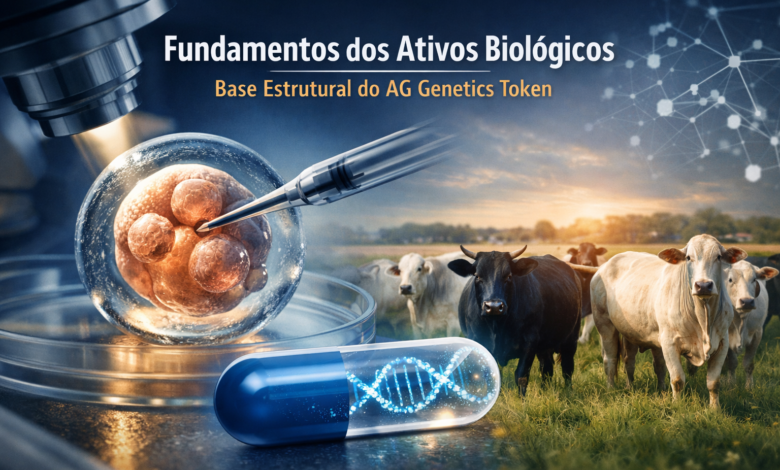
High-performance livestock farming has evolved into a model centered on advanced genetics. The competitive advantage is no longer solely based on production scale, but rather on the genetic quality incorporated into the herds.
In this environment, bovine embryos from superior breeds represent biological assets with structuring economic value.
The AG Genetics Token is based on this structural foundation: before the technology, there is the asset.
This order is strategic. Technical understanding precedes any economic or digital modeling.
Technical Definition of Biological Asset
According to IAS 41 (Agriculture), a biological asset is any living animal or plant controlled by an entity and capable of generating future economic benefits.
When applied to bovine genetics, these include:
- Embryos produced by IVF
- Certified genetic material
- Registered breeders
- Lines with an established market.
These assets have objective characteristics:
✔ Control and identification
✔ Economic measurement
✔ Revenue generation capacity
✔ Integration into a formal production chain
This definition forms the technical basis that underpins any subsequent economic structure.
Documentary Evidence and Materiality
The materiality of an asset can be demonstrated through formal technical documentation.
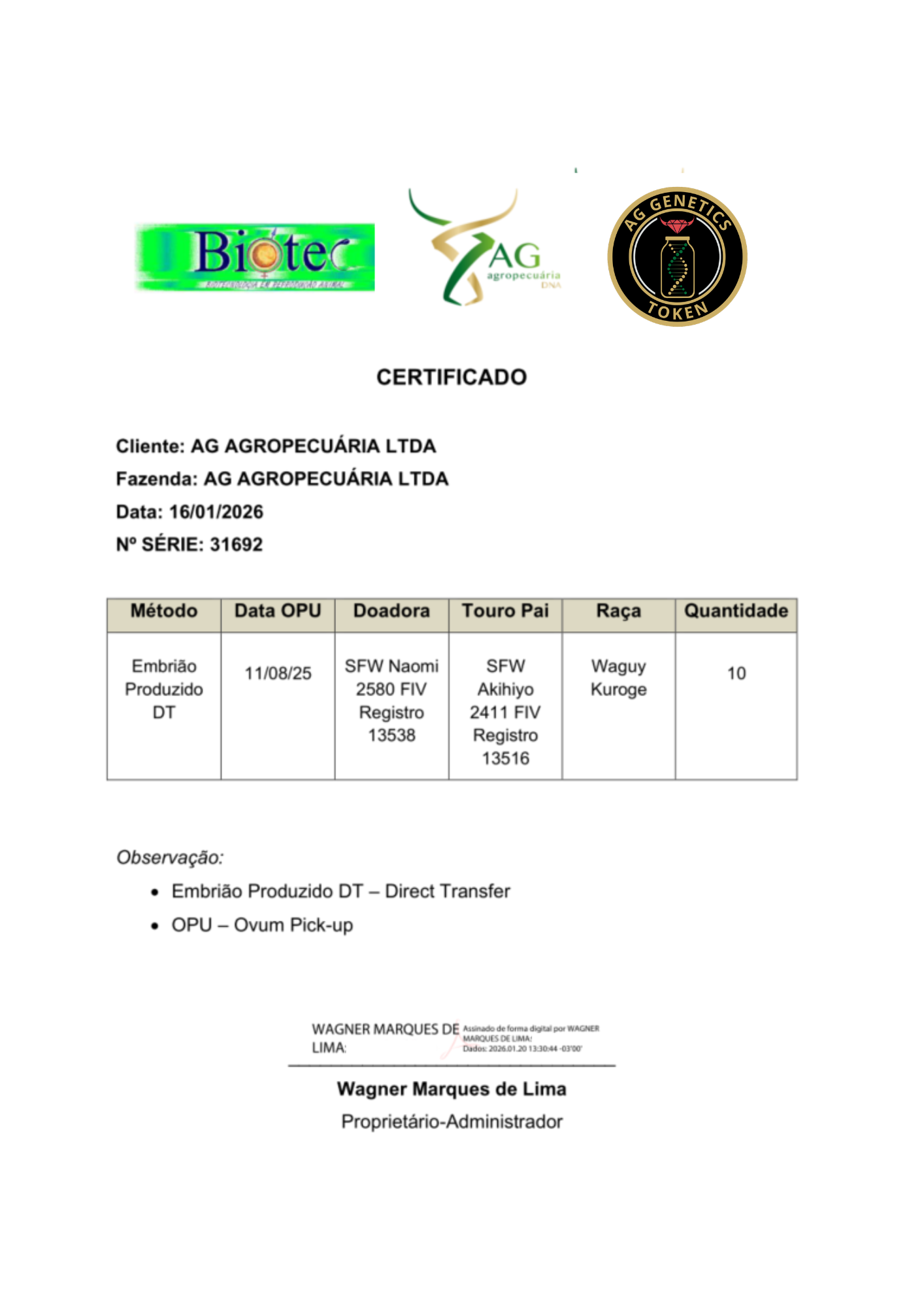
Certificate number 31692 issued by Biotec Serviços de Apoio à Pecuária Ltda records:
- OPU Procedure
- Production by IVF
- Donor and bull identification
- Wagyu Kuroge breed
- Quantity produced
This level of documentation allows for:
- Traceability
- Audit
- Formal inventory
- Basis for economic modeling
The asset ceases to be conceptual and becomes verifiable.
Traceability and Digital Governance
As genetic assets gain economic relevance, so does the need for traceability infrastructure.
A relevant international example is Eggschain, which obtained a patent for tracking genetic material via blockchain, structuring a digital chain of custody for embryos and biospecimens.
This movement highlights a global trend: biological assets require governance, integrity, and structured registration.
The project fits into this evolutionary logic, starting from real assets and consolidated technical documentation.
Economic Fundamentals of the Asset
The economic value of premium genetic embryos rests on three structural factors:
Genetic scarcity – Superior lineages have limited supply.
Cycle predictability Production, implementation, and marketing follow a defined logic.
Active market There is established demand and a history of transactions.
This combination gives the embryo the characteristics of a structurable economic asset.
Technical, Economic and Legal Integration
The project's architecture is based on three integrated dimensions.
Technical Dimension
Validated production, certification, and documented traceability.
Economic Dimension
A structured model for generating revenue from the sale of embryos.
Legal Dimension
Contractual architecture that separates biological asset, governance, and economic participation.
Technology acts as an additional organizational layer, structuring record-keeping and transparency, without replacing the biological foundation.
A technical understanding of biological assets is a necessary condition for any sound economic structure.
By demonstrating its materiality, certification, and insertion in a real market, a solid foundation is established for financial organization and governance.
The project's solidity stems from the order adopted: first the asset, then its structuring.
It is this sequence that gives the model consistency and predictability.







 Portuguese
 English
 Arabic
 Chinese
 French
 Russian
 Urdu
Urdu Spanish