Embryo Transfer and Tokenization: When Genetics Becomes a Strategic Asset in Agriculture

Embryo transfer is one of the most important techniques in modern livestock farming. It democratizes access to superior genetics, reduces the interval between generations, and accelerates herd improvement.
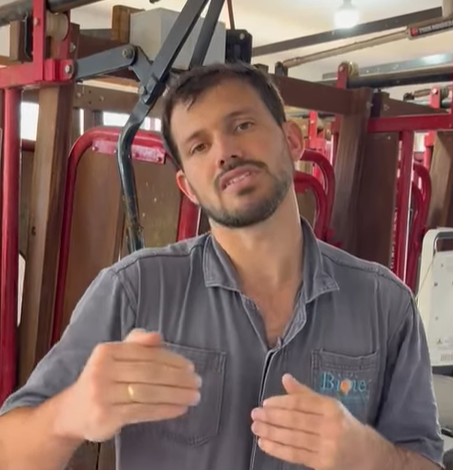
In the video below, the veterinarian Danylo Cintra, partner of BIOTECH, It clearly explains how this reproductive biotechnology directly impacts the formation and evolution of breeding stock.
From this technical explanation, we broaden the reflection here to a strategic point: when genetics ceases to be merely a productive tool and becomes a structured economic asset as well.
Watch the video
The technique that democratizes genetics
As explained in the video, embryo transfer allows a novice producer to have immediate access to genetics that took years to develop.
By acquiring embryos from superior dams, the producer doesn't start from scratch — he starts at the top of the available genetic curve.
This means:
- Shorten the herd's development time.
- Starting the squad already competitive
- Reduce long breeding cycles.
In practice, it's a time jump.
And when time is shortened, the impact is not just biological — it's economic.
Reducing the generation gap: speed is the strategy.
The possibility of using young heifers reduces the interval between generations.
This speeds things up:
- Genetic gain
- Standardization of the herd
- The predictability of results
The shorter the interval, the faster the rate of evolution.
And in modern agriculture, speed of evolution means a competitive advantage.
This is where the natural transition from the technical to the strategic begins.
Standardization creates value — and value can be structured.
Multiplying the best donors allows for the consistent replication of superior traits.
This generates:
- Uniformity
- Standardized quality
- Most valuable product
Standardization is not just about productive organization.
It's about creating predictable value.
Predictable value is the foundation of any economic structure.
From biological asset to economic asset.
An embryo carries:
- Years of genetic selection
- Accumulated technical investment
- Future productive potential
Therefore, it's not just biology.
It is an asset with measurable value.
And when an asset has measurable value and predictable performance, it can be organized economically.
This is the bridge between biotechnology and the financial structure.
Where does tokenization come in?
Tokenization does not alter genetics.
It changes the way assets are organized economically.
In simple terms, it means:
- Structuring batches of embryos as organized economic units.
- Create formal mechanisms for genetic recruitment and expansion.
- Establish governance and objective criteria for participation.
In other words, biotechnology creates the asset.
The financial structure creates the expansion model.
This is not digital speculation.
This is about strategic organization.
The natural convergence
First comes the technique.
Then comes the scale.
Next comes the organization of capital.
Embryo transfer accelerates genetics.
Economic structuring can accelerate expansion.
When these two dimensions work together, the producer ceases to operate solely in the productive sphere and begins to operate also in the strategic sphere.
The BIOTEC video clearly presents the technical benefits of embryo transfer.
The complementary reflection is this: if genetics is a productive advantage, it can also be organized as a structured asset.
Modern agriculture is not just about production.
It is science, management, and economic architecture applied to the field.
And well-structured assets build a sustainable competitive advantage.



 Portuguese
 English
 Arabic
 Chinese
 French
 Russian
 Urdu
Urdu Spanish