Why are some African countries showing increasing interest in high-quality livestock farming?
It's not just about increasing herds, but about seeking productivity, health confidence, and assets capable of sustaining a new phase of agricultural development.
There are market movements that begin quietly.
They don't necessarily arrive in big headlines. Sometimes they appear in a more serious conversation, during an international visit, in a specific request, or in a letter of intent that reveals, in just a few lines, an important change of direction.
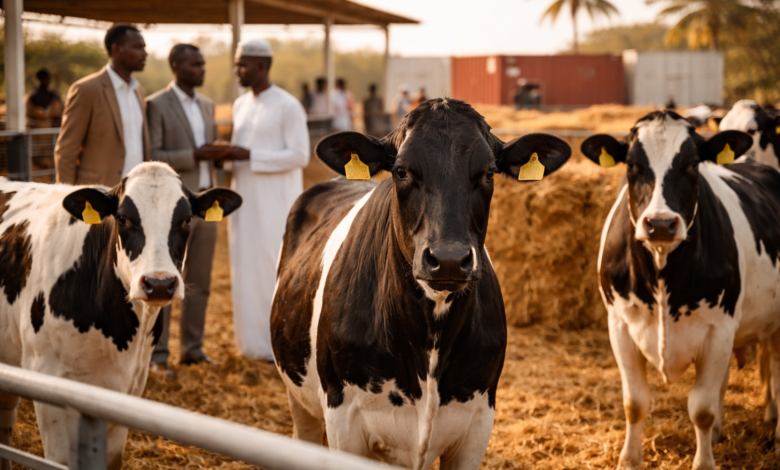
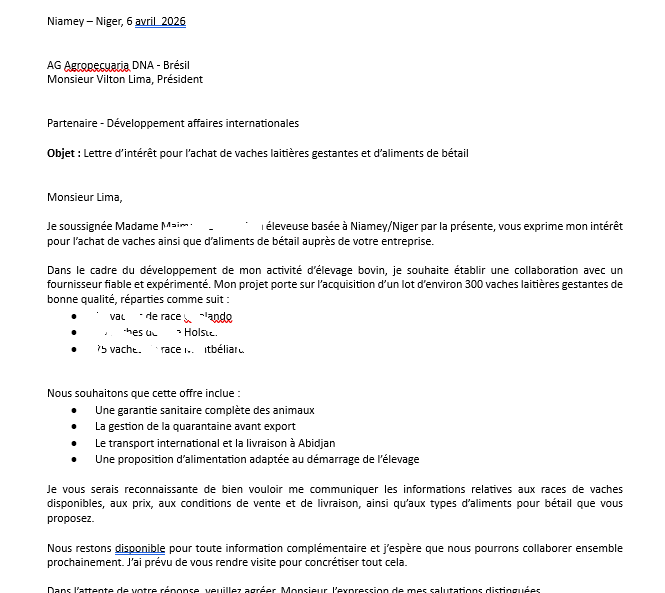
That was exactly the feeling that arose when observing a recent document sent from Niger to AG Agropecuária. The letter contains a formal expression of interest in acquiring approximately 300 pregnant dairy cows, with clear requirements involving animal quality, health guarantees, quarantine before export, international transport, and adequate feed for the start of operations.
This type of demand doesn't arise by chance.
When an international buyer describes with this level of detail what they expect to receive, they are not just looking for animals. They are trying to build a more reliable, efficient, and well-prepared production base to generate results in a timely manner.
A sign that market logic is changing.
For a long time, part of the discussion about livestock farming in emerging markets revolved around herd expansion, increased supply, and economies of scale.
But there comes a point where quantity, on its own, ceases to be sufficient.
When the priority shifts to productivity, food security, domestic supply, milk production efficiency, and operational consistency, the market's perspective changes. At that point, the focus is no longer solely on volume but includes genetics, health, management, adaptation, and predictability. In other words, livestock farming is seen not only as a traditional activity but as part of a larger development strategy. This reasoning aligns with continental agricultural transformation initiatives supported by the African Development Bank, which treat agriculture and value chains as central pillars of economic growth and food security.
That's where the expression comes in. high quality livestock farming It gains strength.
She is not simply pointing to "better" animals in a generic sense. She is pointing to biological assets capable of meeting a more sophisticated market need.
It's not just about buying cattle.
There is an important difference between buying animals and structuring a livestock operation.
Those on the other side of an international negotiation, especially when it comes to pregnant dairy cattle, aren't just thinking about the landing. They're thinking about what happens afterward: adaptation, production, performance, health, continuity, and return on investment.
Therefore, more well-formulated requests are usually accompanied by very concrete concerns. Sanitary guarantee. Quarantine. Logistics. Initial nutrition. Origin. Supplier reliability. All of this naturally arises when the intention is not just to acquire a batch, but to start or strengthen a productive project with greater solidity. The letter received by AG Agropecuária reflects exactly this logic.
This is an important detail.
Markets that mature stop buying based solely on the appearance of opportunity. They begin to buy with more discernment, because the cost of making a mistake is high.
Africa is beginning to show clearer signs of this new quest.
It would be simplistic to talk about Africa as if the entire continent were moving in a homogeneous way. It is not.
Countries have very different realities. The logistical, climatic, productive, and institutional challenges vary considerably. Even so, some recent signs show a growing attention to livestock productivity, especially in the dairy chain, animal breeding, and the ability to reduce external dependence. A very clear example comes from Nigeria, which began importing dairy cows from Denmark as part of a strategy to increase domestic milk production and reduce its annual import bill in the sector. According to Reuters, the country produces about 700,000 tons per year, while consuming approximately 1.6 million tons.
This type of movement helps to better understand the background.
It's not just about "interest in foreign animals." It's about a search for performance, for supply chain reorganization, and for assets that can contribute to real productivity.
When quality stops being just talk and becomes a criterion.
In the market, the word "quality" is used a lot. Sometimes even too often.
But in more demanding operations, quality ceases to be a promise and becomes a decision criterion.
It appears in the breed selection. In the production history. In the health status. In the provenance. In the supplier's ability to organize the process clearly. And it also appears in the way the asset is presented to the buyer.
This point deserves attention.
In international negotiations, especially when significant investment is involved, the perception of value depends not only on the asset itself, but also on the confidence that the asset is able to inspire.
And trust today doesn't just come from sales pitches.
It arises from the organization of information.
The market has come to value what it can understand best.
This is perhaps one of the most important developments in this new scenario.
The more technical and rigorous the market becomes, the less it accepts scattered information, unsubstantiated documents, and vague promises. The buyer wants a clearer understanding of what they are evaluating. They want to understand the origin, sanitary conditions, documentation structure, and overall coherence.
This is where traceability and information organization begin to gain importance, not only as a technical requirement, but also as part of the very perception of value.
Not because they replace the biological quality of the animal.
But because they help this quality to be understood in a more objective way.
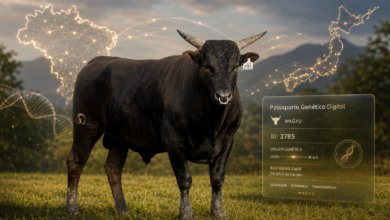
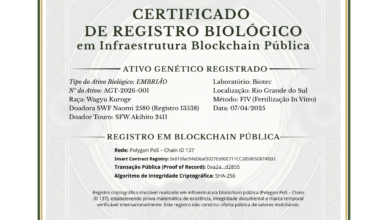
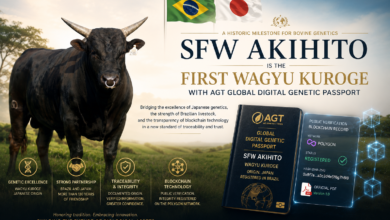
This is where the AGT passport starts to make sense.
When the market starts demanding more clarity, more supporting documentation, and more confidence in what is being traded, tools for organizing and interpreting assets cease to seem like mere accessories.
They come to occupy a strategic place.
O AGT passport It fits perfectly into this context. Its function is not to invent value where it does not exist. Its function is to help organize, structure, and better present a biological asset that already has genetic, economic, and commercial relevance.
In international processes, this can make a difference.
Because a well-documented asset, with organized information and a clearer understanding of its identity, tends to communicate better with markets that are becoming more demanding.
This reasoning is not isolated. Blockchain and chain-of-custody applications for genetic and biological materials already exist in other contexts, including those focused on traceability, integrity, and informational transparency.
What's at stake is not just exports.
Perhaps the most interesting interpretation of this movement is this: we're not just talking about selling cattle.
We are talking about participating in a new way of building trust around valuable biological assets.
When a country, a farm, an investor, or an operator starts looking for more than just animals—also seeking predictability, security, documentation, and trust—the market changes completely.
And when the market shifts to a new level, the way the asset is presented also needs to evolve.
Reflect
The increased interest from some African countries in high-quality livestock should not be interpreted merely as a one-off commercial move.
It can be understood as part of a broader shift: the move from a logic based solely on availability to a logic based on productivity, structure, and trust.
In this environment, genetics matter. Health matters. Logistics matter. But how the asset is organized, understood, and presented to the market is also becoming increasingly important.
It is precisely in this type of context that initiatives such as the AGT passport gain relevance.
Not as a technological adornment.
But this is a coherent response to a market that no longer wants to just hear that an asset has value. It wants to be able to see it more clearly.
 Portuguese
 English
 Arabic
 French
 Spanish