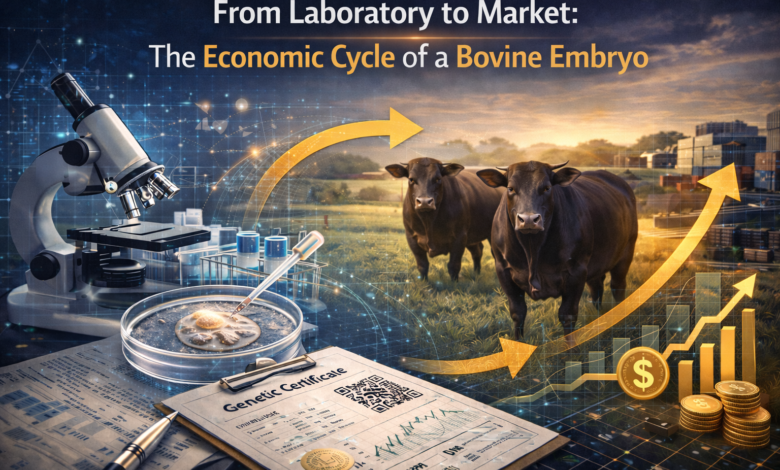
The economic cycle of the bovine embryo begins in the controlled environment of the laboratory and extends to its strategic insertion into the market. Understanding this journey is essential for those who see genetics not only as a productive tool, but as a structuring asset within livestock operations.
In high-performance livestock farming, the embryo is no longer just a reproductive stage. It has become an economic unit with the potential to generate future value.
The beginning of the cycle: genetic planning and laboratory production.
The economic cycle of bovine embryos begins with the careful selection of the donor cow and the bull. This decision determines the genetic potential of the asset.
Oocyte retrieval via OPU (Ovum Pick-Up), followed by in vitro fertilization (IVF), transforms genetic strategy into identifiable biological material. At this point, the embryo already incorporates technical value. It carries productive predictability, performance expectations, and the possibility of commercial differentiation.
Nevertheless, this is potential value. For the economic cycle to consolidate, formalization is necessary.
Formalization and traceability of bovine genetics
Technical formalization is the turning point in the economic cycle of bovine embryos.
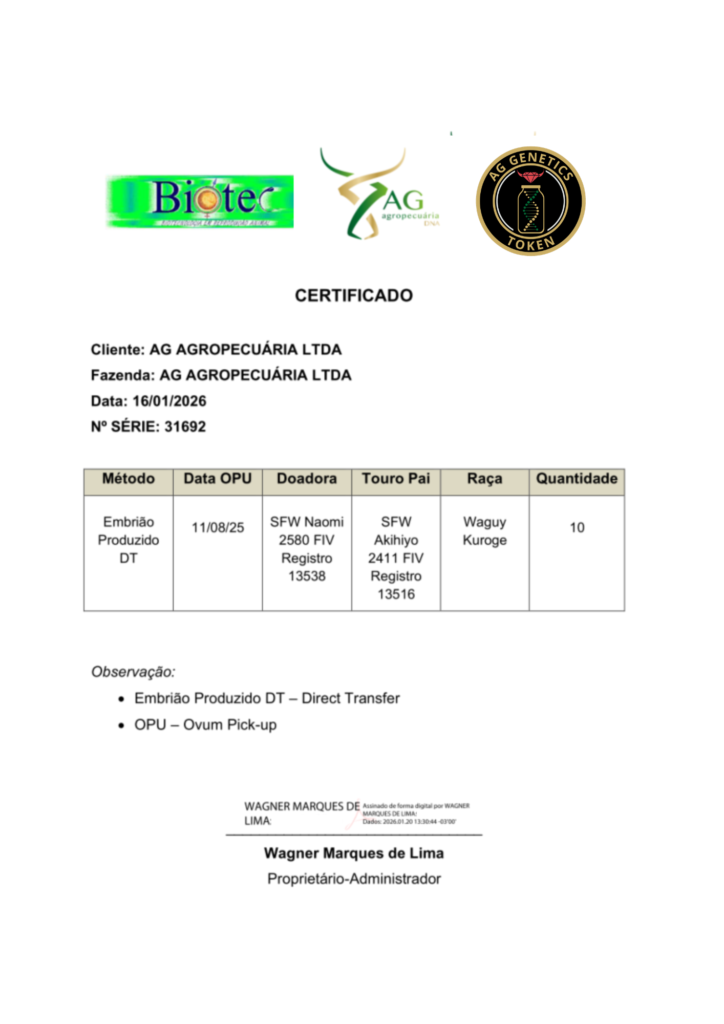
Documents that record donor identification, bull identification, production method, oviposition date, and embryonic classification transform biology into a measurable asset. Without documentation, there is genetics. With documentation, there is an asset structure.
Certificate No. 31692 exemplifies how IVF production can be registered with complete technical identification, including Wagyu Kuroge breed and production method. This level of detail enables inventory, auditing, and governance.
This is where bovine genetic traceability begins to play a strategic role. It reduces information asymmetry. It increases trust. It strengthens value.
Transfer and multiplication of value
After transfer to the recipient, the embryo enters the productive phase of the cycle. The birth of the animal represents an increase in the initial value.
If the genetics meet expectations, the result can generate new embryos, integrate breeding programs, or raise the productive standard of the herd. The cycle ceases to be linear and becomes scalable.
The initial asset multiplies its economic impact.
This is where the economic cycle of the bovine embryo demonstrates its structural strength: a single asset can trigger a chain of value generation over time.
Market entry and governance
The cycle is consolidated when the asset is introduced to the market, whether in the form of a commercialized embryo, elite animal, or premium production.
At this stage, factors such as document governance, genetic predictability, and international control standards come into play. Global initiatives focused on the traceability of biological material indicate that formalizing the genetic chain is likely to become a market requirement.
The embryo ceases to be merely a reproductive element. It becomes integrated into an organized economic structure.
Structure is what transforms biology into economics.
The economic cycle of the bovine embryo reveals that value does not arise solely from productive performance. It is built in stages: genetic planning, controlled production, technical documentation, and market insertion.
Biotechnology creates materiality.
Traceability organizes the asset.
The market recognizes consistency.
When these dimensions are aligned, the embryo ceases to be merely part of the reproductive process and begins to occupy a strategic position within the asset structure of the operation.
In contemporary agriculture, those who understand the complete cycle see more than just production.
He sees economic infrastructure.





 Portuguese
 English
 Arabic
 French
 Spanish